
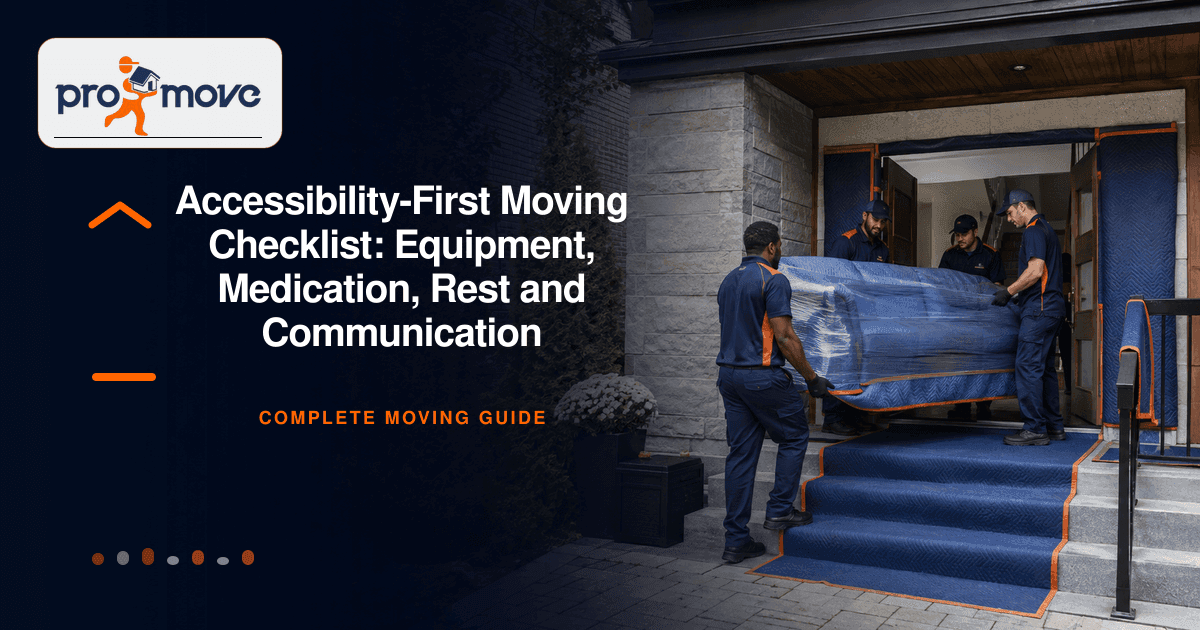
Accessibility first
Build the move around the person, not a standard timetable
An accessibility-first move begins by asking what lets each person participate safely and with control. It does not begin with a diagnosis, a generic disability checklist or an assumption that family members know the answer. Ask the person what must remain available, what creates fatigue or distress, how they prefer information, and which decisions they want to make themselves. Record only the details required to plan the service. A mover needs functional information such as “keep this route clear” or “this device travels with the customer,” not private medical history that does not affect the work.
Separate essential continuity from ordinary convenience. Medication, mobility equipment, communication devices, positioning supports, dietary items and personal-care supplies may need to stay with the individual or support person. Furniture, books and general boxes can follow the moving plan. When one item is essential, identify its owner, transport method, backup, power needs and first-use location. The residential moving service can then be scoped around those facts without asking the crew to make health or equipment decisions outside its role.
This guide is planning information, not medical, occupational-therapy or equipment-service advice. Confirm medication handling with a pharmacist or clinician, and confirm disassembly, battery, lifting and transport requirements with the device manufacturer or qualified supplier. The person’s established care plan takes priority over a general article. The mover should document agreed handling and access, stop when conditions differ, and escalate questions to the customer or authorized support person rather than improvising.
- Ask the person what support makes the move workable and what they want kept private.
- Identify essential items that cannot travel in the moving truck.
- Assign a named owner and backup for every continuity-critical task.
- Use qualified health or equipment guidance for decisions beyond moving work details.
Person-led planning
Hold a private planning conversation before the home survey
Schedule the accessibility conversation at a time and in a format the person can use comfortably. Offer phone, video, email or an in-person discussion where available, and ask whether captions, plain language, extra processing time or a support person would help. Do not make a relative the default spokesperson when the customer can and wishes to communicate directly. If another person is authorized to decide, record the boundary of that authorization and the best way to confirm a change on moving day.
Ask functional, move-specific questions. Which entrance is usable? Are there steps, steep slopes, narrow doors or heavy closers? Is a transfer bench, lift, wheelchair, walker or communication device required until departure? How long can the person comfortably remain in a busy environment? What noise, lighting, scent or crowding should be reduced? What must be set up first at the destination? These answers support logistics without requiring the person to justify why an accommodation matters.
Summarize the conversation in a short accessibility plan and send it back for correction. Use concrete language: “front ramp stays clear until 11:00,” “customer carries labelled medication bag,” or “crew leader sends text before entering.” Avoid broad labels such as “special needs” because they do not tell anyone what to do. Store the plan with restricted access, share only role-relevant details, and include a date for review if health, equipment or property conditions may change.
- Offer a usable communication format and enough response time.
- Ask about routes, equipment, stamina, sensory conditions and arrival priorities.
- Return the written plan to the person for confirmation.
- Share the minimum information each worker needs to perform their role.
Communication profile
Create instructions that still work when the home is noisy
Moving day is loud, fast and visually cluttered, so ordinary communication can fail. Agree on one primary method and one backup: spoken instruction plus text, written cards plus a named support person, or visual confirmation plus a phone call. Record how the crew should announce arrival, identify the decision-maker and request consent before entering a personal space. If the person lip-reads, face them in adequate light and avoid speaking while walking away. If they use an augmentative device, protect time and space for it to be used.
Decide how urgent information will be signalled without causing unnecessary alarm. A single agreed phrase such as “we need to pause for access” is more useful than several workers speaking at once. Use plain, literal instructions and break complex choices into one decision at a time. Never pretend to understand a response. Repeat the agreed action and invite correction. The crew leader should route questions through the designated channel so the customer does not have to answer the same issue repeatedly.
Prepare a one-page communication card that contains no unnecessary diagnosis. It can list preferred name, primary and backup contact method, authorized decision-maker, pause signal, rooms that require permission, and the destination setup priority. Keep a paper copy available if phones fail. Our moving-day communication plan offers a related structure for changes and delays, but the accessibility profile must remain planned for to the individual.
- Choose one primary communication method and one backup.
- Agree on how the crew announces entry, asks permission and signals a pause.
- Use short, concrete instructions and confirm the resulting action.
- Keep an offline communication card without unnecessary health details.
Critical inventory
List equipment by function, ownership and transport plan
Create a critical-equipment inventory before general packing begins. Include mobility aids, transfer equipment, pressure-relief items, communication technology, hearing or vision devices, respiratory or monitoring equipment, chargers, power supplies, adaptive utensils and any repair kit the person routinely uses. Photograph each item from useful angles, record a non-sensitive identifier if appropriate, and note its working condition. The goal is a handoff record, not a medical file.
For each item, state whether it stays in use until departure, travels with the person, is transported by a specialist, or may enter the moving truck under an agreed method. Identify detachable parts, custom settings, safe lifting points, transport locks and manufacturer instructions. Never let a crew guess how a complex device folds or lifts. If the supplier recommends specialist handling, arrange it separately and reflect its appointment in the master schedule.
Match every essential item to its destination location. A charger is not useful if it is in a box three rooms away, and a transfer aid cannot be buried behind furniture. Label the item or case with the room and “open first” instruction without advertising a diagnosis or medication. Give a copy of the inventory to the customer’s equipment lead and a limited handling version to the mover. Use the specialty item moving page to discuss unusual transport requirements early.
- Photograph condition and all detachable components.
- Record who owns, transports and receives each essential device.
- Keep manufacturer or supplier instructions with the item.
- Name the destination room and setup order before loading.
Medication continuity
Keep medication under personal control throughout the move
Medication should normally remain with the person or a trusted support person rather than enter the moving truck. Health Canada advises keeping medications in their original labelled containers and not combining different products in one bottle. Prepare enough supply for the planned move plus a reasonable delay discussed with the pharmacist or prescriber. Carry the current prescription or medication list in the format the person already uses, and protect private information from casual viewing.
Ask the pharmacist about temperature, light, security and timing requirements for the actual medication. Do not infer that an insulated bag, ice pack or vehicle glove box is suitable. If refrigeration or another controlled condition is required, obtain a written transport plan and identify backup power or an alternate safe location. Movers should not pack, administer, refrigerate or make decisions about medication. They only need to know which cooler, bag or route must remain unobstructed when that information affects access.
Build the dosing schedule around travel and rest, not around the truck’s convenience. Use alarms that remain active offline, and keep water, food or supplies required for ordinary administration accessible where advised. If medication is lost, damaged or exposed to an uncertain condition, contact a pharmacist or health professional for direction rather than guessing whether it remains usable. An essentials box checklist can organize general personal items, but medication should retain its own controlled handoff.
- Carry medication with the person or designated support person.
- Keep original labels and an up-to-date medication or prescription record.
- Confirm storage and temperature needs with a pharmacist.
- Plan for delay without changing doses or handling instructions independently.
Personal carry kit
Pack a 72-hour continuity bag that is not loaded on the truck
Government of Canada emergency-preparedness guidance encourages people with disabilities to keep instructions, contacts, medical information, medication and disability-specific supplies ready. A move is not an emergency, but the same continuity principle is useful because a truck delay can temporarily separate the household from packed goods. Prepare a portable bag for at least the first days at the destination, scaled to the person’s established needs and professional guidance.
Include communication and mobility-device chargers, batteries approved for the equipment, basic repair items, personal-care supplies, dietary essentials, copies of key instructions, emergency contacts, identification, keys and a change of clothing. Add comfort or sensory-regulation items that make an unfamiliar space manageable. Weight and carrying method matter: the kit must be usable by the person or assigned helper, not merely complete on paper.
Attach a simple custody rule. The bag stays with a named person, is never placed in the loading zone and moves from old-home safe place to vehicle to new-home safe place. Use a neutral label instead of “medical supplies” where privacy or theft is a concern. Check the contents and device charge the evening before departure. If one container is too heavy or complex, split it into clearly paired modules and list who carries each one.
- Keep the continuity bag out of the truck and loading zone.
- Include communication, mobility, personal-care and comfort essentials.
- Make the weight and carrying arrangement realistic for the assigned person.
- Use a custody log when the kit changes hands.
Pacing
Design the schedule with rest before fatigue becomes a crisis
Rest is a scheduled access requirement, not an optional reward after packing. Ask the person when energy, pain, concentration or medication effects usually make activity easier or harder. Put critical decisions and travel inside the most workable window where possible. Add buffers around waking, personal care, meals, transfers and departure. A schedule that uses every available minute is fragile because one delayed elevator or misplaced box can remove the only planned break.
Choose a quiet rest room at both properties and keep it outside the crew’s route. Set it up with seating or positioning support, water, communication device, charger, required personal supplies and a visible “do not enter without permission” notice. Do not use the room for overflow boxes. If the destination cannot offer a ready room, arrange an alternate accessible place with a trusted person or suitable facility before moving day.
Agree on a pause protocol that does not require explanation in front of the crew. The customer or support person can use the agreed word or message, and the crew leader confirms what work can continue elsewhere. Time-based reminders are useful, but the person’s current condition matters more than a preset interval. If the move must extend, revise work details and timing transparently rather than pushing through fatigue and increasing risk.
- Place critical decisions inside the person’s most workable time window.
- Protect a quiet room at origin and destination.
- Use a no-explanation pause signal.
- Keep schedule buffers around meals, medication, transfers and travel.
Origin survey
Map the usable route before boxes narrow it
Survey the path from the person’s main room to the exit before staging begins. Measure door clearances where equipment fit is uncertain, note thresholds, ramps, lifts, turns, flooring transitions and door closers, and identify where a vehicle can stop legally. Look at the route in the conditions expected on moving day, including snow, rain, poor lighting or construction. Photographs help the moving planner, but obtain permission and avoid capturing private health information.
Mark a protected lane wide enough for the person’s actual mobility method. Furniture pads, dollies, cartons and removed doors must never occupy it. If the same entrance serves the crew and customer, schedule crossings rather than expecting everyone to negotiate at once. Keep a second emergency exit usable where the property allows. CCOHS guidance on preventing falls and safe material handling reinforces the importance of clear, stable routes and planned handling rather than improvised movement on stairs.
Check the final hours of use for beds, lifts, rails, shower supports and seating. Some items cannot be packed until after personal care; others need a specialist. Put these dependencies in the load order. The packing and moving service should receive the approved staging zones and no-pack list before materials arrive, so well-intentioned packers do not dismantle essential support.
- Measure uncertain clearances using the device’s real operating width.
- Protect the route before any carton or dolly is staged.
- Schedule shared-doorway use when customer and crew routes cross.
- Place late-use supports explicitly in the load order.
Destination survey
Verify the route to the first-use rooms, not only the front door
A step-free entrance does not guarantee a workable destination. Trace the full path from vehicle to bedroom, bathroom, rest area and charging location. Confirm door widths, hallway turns, lift dimensions, threshold height, floor condition and space to position equipment. Note whether construction, stored belongings or snow removal could change the route between survey and moving day. Ask the person which route is acceptable; the technically shortest path may be noisy, exposed or otherwise unsuitable.
Create a first-placement plan for the bed, seating, chargers, mobility aids and personal-care equipment. Mark floor positions only with materials permitted by the property and remove them after use. Keep electrical outlets accessible without running cords across circulation paths. If a room cannot support the required equipment, resolve that before the truck is loaded through the landlord, owner, clinician, equipment supplier or relevant trade.
Photograph the empty accessible route and final first-use setup with permission. These images help detect misplaced boxes and support a condition record; they are not marketing material. Give the crew a simple destination diagram with protected paths and “place first” zones. The unpacking service can be scoped to restore ordinary rooms later, while continuity-critical setup remains under the person’s or qualified support team’s direction.
- Trace the route to bathroom, bedroom, rest and charging points.
- Resolve equipment-placement conflicts before loading day.
- Keep cords and cartons outside circulation paths.
- Use a simple first-placement diagram approved by the person.
Building coordination
Reserve elevators and doors without removing independent access
In an Ottawa apartment or condo, request the moving rules, elevator dimensions, loading location and door-control process early. Explain the functional access requirement without disclosing medical details. A service elevator booking should not trap the resident on one floor or disable an automatic door they rely on. Ask how staff will restore ordinary access between loads and who responds if an elevator fails.
Confirm accessible parking or passenger-drop-off separately from the moving truck space. A legal loading position may still be too far or steep for the person’s route. Plan the customer’s arrival and departure outside the busiest material-handling interval where possible. If a concierge must operate a lift or unlock a route, include their contact and backup in the day sheet. Never prop a fire door or defeat an access-control device without building authorization.
Provide the property manager with the exact time windows and a concise access request. Keep written approval with the move file. If the building cannot provide the expected elevator, do not default to carrying a person or complex mobility device on stairs. Pause and use the person’s established contingency or emergency plan. Our apartment moving page explains common shared-building logistics that should be reconciled with the accessibility plan.
- Book moving access and personal accessible access as related but separate needs.
- Name the building contact and elevator-failure backup.
- Keep fire and security doors operating as authorized.
- Never improvise stair transport for a person or specialized device.
Travel plan
Choose accessible transportation and a realistic arrival sequence
The customer’s travel plan is separate from the household-goods truck. Confirm who drives, where the mobility device travels, how transfers occur, and whether the vehicle can wait safely at both properties. If using accessible transit, taxi or a community service, book according to its current eligibility and reservation rules. Ottawa’s transit accessibility information identifies Para Transpo as a pre-booked service for eligible customers who cannot use conventional transit because of a disability; verify current arrangements directly.
Place travel after the origin’s essential personal-care and equipment steps, but before the destination becomes crowded. Give the receiving person enough time to unlock, inspect the rest room and confirm the accessible path before unloading critical items. If the customer prefers to arrive after the main unloading, identify who has authority to place items and how the final setup will be approved. Avoid leaving the person waiting in a vehicle because the moving schedule slipped.
Prepare route and weather alternatives. Construction, snow, elevator downtime or a vehicle problem can change the planned transfer. Keep the driver, support lead and crew leader connected through the agreed communication channel, and update only facts. If a delay affects medication, equipment power or personal care, follow the person’s professional continuity plan rather than a mover-created service.
- Book personal transportation independently from the moving truck.
- Confirm device securement and transfer needs with the transport provider.
- Arrange a safe waiting alternative that is not a parked vehicle by default.
- Share delay updates through one agreed communication channel.
Support network
Assign roles without taking control away from the customer
Name specific roles: customer advocate, medication custodian, equipment lead, transport contact, origin closer and destination receiver. One person may hold more than one role, but no critical task should depend on an unnamed “family member.” Confirm who can authorize work details changes and spending, and who can receive private health information. Support people should enable the customer’s decisions, not substitute their preferences without authority.
Create a contact ladder for ordinary questions, urgent access problems and emergencies. The mover calls the crew leader first; the crew leader contacts the customer or authorized decision-maker; health and equipment concerns go to the designated professional or supplier. Keep emergency services available for genuine emergencies. This sequence prevents five people from offering contradictory instructions in a crowded room.
Brief supporters on boundaries. They should not ask crew members to lift a person, operate unfamiliar medical equipment or administer medication. They should protect the rest space, keep personal items under control and relay confirmed decisions. Schedule relief for a long day, because an exhausted support person is a single point of failure. Record handoffs when the medication bag, keys or equipment documentation changes custodian.
- Name the decision-maker and the limit of each person’s authority.
- Assign medication, equipment, transport and property-closing roles.
- Use one contact ladder for crew questions.
- Plan relief and document custody changes.
Mover briefing
Translate accessibility needs into observable crew actions
Give the mover a concise, customer-approved brief before the estimate is finalized. Include accessible entrances, protected routes, no-pack items, late-use equipment, rest-room boundaries, communication method, service-elevator details and specialist appointments. Ask the company to confirm whether its planned crew, equipment and schedule can meet the stated logistics. An accommodation is not useful if it remains an informal promise known only to the salesperson.
At the start-of-day briefing, the crew leader repeats the operational points without announcing a diagnosis. Use statements such as “keep the blue-tape path open,” “ask Alex before entering the back room,” and “the black case never goes on the truck.” Invite the customer or support lead to correct the summary. Record any new property condition and revise the sequence before work begins.
Do not describe ordinary safety boundaries as optional customer preferences. Clear egress, stable routes and appropriate handling protect everyone. CCOHS ergonomic guidance emphasizes assessing the load, path and available assistance before handling. A moving crew should use its trained methods and equipment, while specialized device instructions come from the manufacturer or supplier. If these requirements conflict, pause and obtain a safe plan instead of forcing the item into the schedule.
- Put agreed accessibility logistics into the quote or move plan.
- Repeat only functional instructions during the crew briefing.
- Invite correction before loading begins.
- Pause when moving methods and device instructions conflict.
Packing boundaries
Use a no-pack system that cannot be mistaken for colour coding
Create a physically separate no-pack zone for medication, personal documents, communication devices, daily mobility aids, keys and the continuity kit. A coloured sticker alone is too easy to miss when many boxes use the same labels. Use a closed room, locked vehicle compartment under the customer’s control or a clearly guarded area outside the loading path. Tell every crew member at the briefing and place the same rule on the inventory.
Pack adaptive kitchen, bathroom and dressing items according to their first-use order. A small object may be more important than a large piece of furniture if it enables eating or personal care. Use descriptive labels such as “open first: bathroom supports” rather than medical diagnoses. Photograph the closed carton, number it and place it near the truck door only if it is approved for mover transport.
Avoid compressing cushions, pressure-relief materials, braces or custom supports unless the supplier says the method is safe. Do not use tape on device surfaces without approved protection. Batteries, liquids, aerosols and sharps may have transport restrictions or special handling needs; identify them during the estimate, not at the loading door. The packing services page can support general materials and labelling while specialist instructions govern essential equipment.
- Use a separate guarded no-pack zone, not stickers alone.
- Label adaptive items by first-use room and function.
- Do not compress custom supports without supplier approval.
- Declare batteries, liquids and other restricted items before moving day.
Mobility devices
Document wheelchairs, scooters, walkers and transfer aids component by component
Record the device in its working configuration, then photograph every removable component and connection before any authorized disassembly. Note cushions, controllers, footrests, headrests, baskets, chargers, keys and transport locks. Keep small parts in a labelled container attached only where the manufacturer permits. A custom wheelchair is not simply furniture; its fit and settings can be essential to the user’s health and independence.
Ask the manufacturer, dealer or qualified technician how the specific model may be lifted, folded, powered down, secured and transported. Battery chemistry and air-travel rules are not relevant substitutes for the actual road-transport plan. Never lift by an armrest, joystick or detachable part unless the instructions identify it as a lifting point. Use ramps and handling equipment rated for the combined task, and keep the user’s transfer plan separate from device loading.
Arrange an immediate inspection at the destination before the crew leaves. Compare photographs, confirm parts are present and allow the user or equipment lead to test only within their usual safe practice. Record visible damage without attempting a repair. Keep the supplier contact, serial information and any insurance or valuation record accessible. Where the device must remain with the person, do not place it on the moving inventory merely for convenience.
- Photograph the complete device and each removable component.
- Use model-specific supplier instructions for lifting and securement.
- Keep controllers, cushions, keys and chargers under named custody.
- Inspect immediately at destination and document differences.
Powered and clinical equipment
Plan electricity, batteries and specialist handoffs without guessing
List each powered device’s normal supply, approved backup, charging time and acceptable interruption as confirmed by the user’s clinical or equipment team. Check outlets and space at the destination before the move. Do not use unapproved extension cords, converters, generators or vehicle power. If continuity depends on utility service, confirm the account and outage plan early through the relevant provider.
Equipment involving oxygen, compressed gas, suction, refrigeration, monitoring or other clinical functions needs an individual plan. Movers may prohibit certain cylinders, batteries, liquids or hazardous materials, and a medical supplier may require specialist transport. Reconcile both sets of rules in writing. Never conceal the item to keep the schedule. Arrange delivery, pickup or technician service so the person retains the required support throughout the transition.
Protect cables and accessories against pinching, moisture and loss, while preserving the settings the supplier says should remain. Photograph connections before disassembly and label both ends without covering warnings or vents. At arrival, keep equipment in its approved orientation and wait for the authorized person to reconnect or verify it. The crew can place an item where directed but should not certify that it is clinically ready.
- Confirm power and interruption limits with the qualified equipment team.
- Reconcile mover restrictions with supplier transport instructions.
- Never hide a cylinder, battery or clinical item from the carrier.
- Assign reconnection and readiness checks to the authorized person.
Sensory access
Reduce avoidable noise, light, scent and visual overload
Ask which environmental conditions make communication or regulation easier. Moving commonly introduces tape noise, alarms, open doors, unfamiliar workers, strong cleaning products and rapidly changing room layouts. Choose a quiet zone, limit simultaneous questions and warn before loud or abrupt work where practicable. Do not promise silence that the move cannot deliver; provide predictable information about what will happen and when.
Use a visual schedule that shows a small number of current stages rather than the entire day at once. Mark completed steps and explain changes before rearranging the board. Keep familiar comfort items, headphones, tinted lenses or other established supports in the personal carry kit. Avoid introducing scents through air fresheners or cleaning products without asking. These measures can help many people and do not require the crew to know a diagnosis.
Reduce visual clutter along the customer’s route by staging boxes in defined zones. Keep doors either consistently open where authorized or consistently managed so the route does not change unpredictably. If a person needs advance notice before workers enter a room, put that instruction on the door and in the crew brief. The aim is predictability and control, not isolation from every ordinary moving sound.
- Identify triggers and useful supports without demanding a diagnosis.
- Warn before loud work and limit simultaneous questions.
- Use a short visual schedule and mark changes clearly.
- Keep customer routes visually stable and free of staging clutter.
Cognitive access
Make decisions smaller, visible and reversible where possible
A long sequence of open questions can become inaccessible under fatigue or stress. Present one decision at a time, explain the immediate consequence and offer a clear default only when the customer has agreed to that approach. Use photographs or room diagrams for placement choices. Record the answer so another crew member does not ask again. Allow processing time without filling the silence or treating delay as refusal.
Protect familiar routines during the transition. Keep the same medication, meal, rest and communication schedule where possible; identify the few unavoidable changes in advance. Place orientation cues at the destination, such as room labels or a familiar object, with the person’s approval. Avoid unpacking every visual item at once if gradual setup is easier. A support person can guide the sequence without overriding the resident’s choices.
Prepare a stop point for decision fatigue. Nonessential furniture placement can wait, while the bed, bathroom access, essential equipment and safe circulation cannot. Give the crew a written fallback for undecided ordinary items, such as placing labelled cartons in one spare room without blocking the route. This keeps the move progressing without turning uncertainty into permanent placement decisions.
- Offer one decision at a time with a visible consequence.
- Record answers so questions are not repeated.
- Preserve familiar routines and agreed orientation cues.
- Use a safe holding zone for nonessential undecided items.
Vision and hearing
Provide reliable orientation and alerts in the preferred format
For a person with low vision or blindness, describe changes to the route before they occur and keep furniture, tools and boxes out of the protected path. Do not move a cane, guide-dog equipment or tactile marker without permission. Offer an elbow or guidance only in the method the person requests. Use high-contrast or tactile labels where helpful, and keep doors, cords and floor coverings in consistent, safe positions.
For a person who is Deaf or hard of hearing, agree on text, captioned call, relay, written note or in-person communication. Ensure the crew leader’s face is visible when speech reading is used. Replace shouted updates from another room with the agreed channel. Test visual or vibrating door and phone alerts after setup if the resident requests it, but leave technical configuration to the owner or qualified support.
Emergency information must use the same accessible method. The communication card should explain how to alert the person if the crew must pause or leave, and who confirms that the message was understood. Accessible Standards Canada guidance on emergency communication highlights the importance of considering communication barriers rather than assuming one spoken announcement reaches everyone. Keep the plan proportionate to the move and approved by the person.
- Describe route changes and never relocate orientation aids without consent.
- Use text, captions, relay or other preferred methods consistently.
- Make the speaker visible where speech reading is used.
- Deliver urgent information through the same accessible channel.
Service animals
Protect the working relationship and create a controlled transition
Ask the handler how the service animal should move through the day and what crew behaviour supports safe work. Do not pet, feed, call or distract the animal. Keep harnesses, food, water, medication, cleanup supplies and veterinary contacts with the handler or named support person. Create a quiet, secure space away from open doors and moving equipment, while preserving the animal’s ability to assist as directed by the handler.
Plan travel and destination orientation with the handler. The animal may need time to learn new exits, relief areas and interior routes before rooms fill with boxes. Keep chemicals, sharp packing debris and food waste out of reach. Tell the handler before using loud equipment or opening a secured door. If a worker has an allergy or fear, the moving company should manage staffing and distance respectfully rather than asking the handler to give up needed assistance.
A pet is not automatically a service animal, but any animal can add door and travel risks during a move. Use a separate pet plan for crates, identification and care. The accessibility brief should contain only the operational facts about the service animal that the crew needs. Questions about legal rights or public access should be addressed through current authoritative guidance, not debated at the loading door.
- Follow the handler’s directions and do not distract the animal.
- Keep animal supplies and documentation with the handler.
- Control open doors, debris and loud-work notifications.
- Plan time for destination orientation before heavy traffic resumes.
Weather and outages
Prepare for Ottawa heat, cold, snow and loss of power
Ottawa weather can change accessible routes quickly. Snowbanks may block curb cuts, ice may make ramps unsafe, heat can increase fatigue, and heavy rain can affect equipment. Check the forecast and property conditions, then confirm who clears and treats the route. Do not assume the moving crew can shovel a public or building access path unless that work is explicitly arranged and safe.
A power outage can disable elevators, automatic doors, lifts, chargers, heating and communication equipment. Record the property’s authorized outage procedure and the person’s established backup. Charge approved batteries, but never substitute a new power source without equipment guidance. If the destination cannot support essential equipment, use the prearranged alternate location or professional advice rather than proceeding because the truck has arrived.
Choose thresholds for delay or postponement before moving day. Examples include an unavailable accessible entrance, unsafe ramp, elevator outage with no approved alternative, or inability to maintain an essential equipment plan. The crew leader, customer and property contact should know who makes each decision. A transparent delay is safer than improvised lifting or leaving a person in an inaccessible home.
- Inspect curb cuts, ramps and drop-off areas after weather changes.
- Confirm who is responsible for snow and ice removal.
- Use only approved backup power for essential equipment.
- Set delay thresholds before the moving truck is loaded.
Moving-day zones
Separate the crew route, customer route and quiet zone
Mark three zones at both homes. The crew route connects staging and truck. The customer route connects essential rooms and exit. The quiet zone supports rest and communication. Where routes cross, assign a spotter or schedule a temporary pause in material handling. Do not rely on everyone remembering; use removable signs or floor markers approved for the surface and explain them during the briefing.
Keep dollies, straps, doors, tools and protective materials inside the crew zone. Keep medication, devices, continuity bags and service-animal supplies inside the customer-controlled zone. The quiet room should not become a place for empty cartons or staff breaks. Check all three zones after each major stage because furniture removal can expose cords, uneven flooring or sharp debris.
Use one crew member to manage door and route changes rather than allowing several simultaneous adjustments. When the customer needs to pass, stop traffic and confirm the route is ready. Do not rush the person through a narrow window between loads. At destination, establish the customer route before the first large item enters. This simple zoning reduces conflicts without requiring specialized equipment.
- Mark crew, customer and quiet zones at both properties.
- Schedule crossings instead of negotiating them during a carry.
- Reinspect routes as rooms empty or fill.
- Establish the destination customer path before unloading.
Day-of continuity
Protect meals, medication, personal care and rest from schedule drift
Write the person’s essential daily events into the same timetable as the elevator and truck. Use the established medication and meal schedule from the individual’s care plan, not a schedule invented for the move. Give personal-care routines privacy and realistic time. If the move runs late, the support lead protects those events while the crew leader adjusts work elsewhere.
Keep suitable food, water and dietary supplies under the assigned person’s control. Do not place them in a refrigerator that may be disconnected or a cooler whose temperature has not been approved. Confirm an accessible washroom remains available until departure and is functional on arrival. The customer should not have to cross a loading path to reach essential facilities.
Record fatigue, pain or distress only to the extent the person wants and the move needs. The operational decision might simply be “pause for 30 minutes” or “customer travels now,” not a medical explanation. If symptoms raise an urgent health concern, contact the appropriate health or emergency service according to the person’s plan. Movers should never diagnose, advise a dose change or pressure someone to continue.
- Put personal-care and rest events on the master schedule.
- Keep appropriate food, water and supplies personally accessible.
- Maintain a usable washroom outside the loading route.
- Communicate operational decisions without unnecessary health detail.
Contingencies
Write responses for the few failures that would stop the move
Identify the high-impact failures: essential device damaged, medication inaccessible, accessible vehicle delayed, elevator unavailable, destination power off, support person absent or rest space unusable. For each, name the first action, decision-maker, contact and safe waiting location. Keep the list short enough to use. Ordinary placement errors can wait; continuity failures cannot.
The backup must be real and authorized. “Use the stairs” is not a plan for a wheelchair user, and “buy another charger” may be impossible for proprietary equipment. Confirm alternate transport, supplier support, power, accommodation or care through the relevant provider before relying on it. Government emergency-preparedness guidance recommends a support network and personal instructions; adapt that principle to the moving day without calling every inconvenience an emergency.
Set the escalation boundary. A mover handles service and property issues within its contract; a building manager handles common systems; an equipment supplier handles device guidance; a clinician or pharmacist handles health questions; emergency services handle emergencies. The customer or authorized person coordinates these roles. Document the time, facts and decision, especially when work pauses or the destination changes.
- List only failures that threaten access, continuity or safe occupancy.
- Use verified alternatives rather than hopeful substitutes.
- Match each problem to the responsible provider or professional.
- Document facts and decisions when the plan changes.
Arrival priorities
Set up one complete accessible living loop before decorative unpacking
The first objective at destination is a usable loop between entrance, rest space, washroom, essential equipment, medication and communication. Place the bed or approved seating, mobility aids, chargers and personal-care supplies before general décor. Confirm pathways with the person using their actual mobility method. A room that looks clear to a standing observer may not allow turning, transfer or device access.
Reconnect or assemble only within the authorized role. Movers can place ordinary furniture and assemble items included in their contract; qualified supporters or technicians handle specialized equipment. Compare components with the critical inventory and photograph the completed setup with permission. Keep packaging until the person or equipment lead confirms that all parts are present and undamaged.
Add familiar orientation and communication items gradually. Confirm lighting, visual alerts, reachable controls and the agreed quiet space. Keep a small open-box station outside the circulation path so essential cartons can be unpacked without scattering materials. The first 48 hours in a new home guide covers broader arrival tasks after the accessible living loop is secure.
- Build an entrance-to-rest-to-washroom accessible loop first.
- Test clearances with the person’s real mobility method.
- Assign specialized setup to the qualified person.
- Keep packaging until components and condition are verified.
Inspection
Check equipment and access before the support team leaves
Use the critical inventory to inspect every essential item. Confirm quantity, visible condition, components, charger and destination location. Invite the user or equipment lead to conduct functional checks within their normal safe process. Do not ask the moving crew to power up unfamiliar devices. Record a discrepancy immediately with photographs, inventory references and neutral language.
Walk the customer route and remove wrap, tape, cords, tools and carton edges. Check door operation, thresholds, washroom approach, bed access and emergency exit. Confirm that boxes have not covered controls, vents, outlets or equipment access. If ordinary furniture blocks a required route, reposition it before releasing the crew rather than planning to solve it later.
Review keys, building fobs, communication device, medication bag and personal documents with their custodians. Close each handoff explicitly. If a claim or repair may be needed, preserve the item and documentation and follow the contract or supplier process. Do not discard packaging, alter the device or promise an outcome before the responsible party has reviewed the facts.
- Inspect all essential items against photographs and inventory.
- Clear packaging and tools from the accessible route.
- Confirm custody of keys, medication and communication devices.
- Preserve evidence and follow the proper claim or repair channel.
First night
Keep the plan small enough for a tired household to follow
The first night should prioritize medication, food, personal care, charging, sleep and a clear route. Do not schedule nonessential unpacking into the only rest window. Place a lamp or control method the person can use, confirm the phone and backup communication work, and keep emergency contacts visible in the preferred format. Test smoke and carbon-monoxide alarms according to the owner’s responsibilities and product guidance without delaying urgent personal needs.
Review temperature and equipment conditions before support people leave. Confirm who is available overnight and what contact method will reach them. If the person uses home care or another scheduled service, verify the provider has the correct address, entry instructions and start time through the authorized channel. Mail forwarding alone does not update care, pharmacy or government records.
Leave general boxes closed unless they support an immediate task. Keep a waste bag and small tool kit with the authorized assembler, but remove blades and hazards from circulation paths. Take a final photograph of the accessible loop if the resident wants a reference for restoring it after later unpacking. The household can then stop, rest and resume from a stable baseline.
- Prioritize medication, food, personal care, charging and sleep.
- Confirm overnight support and accessible communication.
- Update authorized care providers with the actual address and access details.
- Leave nonessential boxes closed until rest needs are met.
First week
Review what worked and correct barriers before they become normal
Within the first week, ask the resident what remains difficult. A box may narrow a route, a charger may be unreachable, glare may affect communication, or the scheduled rest area may not work in daily life. Correct practical barriers while the move plan and inventory are still available. Do not dismiss a repeated workaround as temporary if it affects safe, independent use of the home.
Complete address updates for health cards, driver’s licences or other Ontario and federal services using current official processes. Contact pharmacies, equipment suppliers, care providers and emergency contacts directly where the person authorizes it. The ServiceOntario address-change guide can organize public-document tasks, while each private provider still needs its own update.
Close the move record carefully. Retain equipment condition photos, specialist instructions, claim documentation and agreed communications for as long as they are needed. Delete unnecessary medical details from shared crew files. Record lessons for a future move: useful rest interval, successful communication method, route measurements and equipment lead time. The best accessibility plan becomes shorter and more precise because it reflects what the person found effective.
- Ask the resident to identify remaining barriers in ordinary daily use.
- Update public records and private providers through separate processes.
- Remove unnecessary health information from shared move documents.
- Capture the person’s lessons for future transitions.
Quick-reference checklist
Use the accessibility-first move sequence from six weeks to seven days after
Six weeks out, hold the person-led planning conversation, survey both routes and identify specialist equipment needs. Four weeks out, confirm transport, building access, utility continuity and the critical inventory. Two weeks out, issue the crew brief, protect rest windows and verify support roles. Three days out, charge devices, complete the continuity kit and check weather. Moving day, protect routes, communication, medication and paced decisions. At arrival, create the accessible living loop. During the first week, remove remaining barriers and close records.
The core documents are intentionally small: one customer-approved accessibility plan, one critical-equipment inventory, one day schedule, one communication card and one contingency sheet. Cross-reference them instead of copying sensitive information repeatedly. The medication custodian does not need the mover’s pricing, and the crew does not need the medication list. Give each person the minimum accurate information for their role.
Recheck every plan when the person’s needs, equipment, weather, property access or support availability changes. Accessibility is not a promise that nothing unexpected will happen. It is a method for making routes, information, rest, equipment and decisions usable: and for pausing when the agreed conditions are not present. A free Ottawa moving quote should describe these functional logistics early enough for the company to confirm work details, timing and appropriate resources.
- Person-led accessibility plan
- Critical-equipment inventory and condition photos
- Medication and continuity carry kit
- Protected origin and destination routes
- Rest, communication and support schedule
- Verified contingencies and destination inspection
Research record
Sources used for this guide
These primary and authoritative references informed the practical details above. Page availability should be reviewed during the regular editorial refresh.
- CCOHS ergonomics and lifting guidancePrimary Canadian handling-safety research.
- Government of Canada : Emergency preparedness for persons with disabilitiesPrimary Canadian guidance on individualized emergency plans, support networks, medication records, assistive devices and alternate power needs.
- Ontario : Emergency preparedness guide for people with disabilitiesPrimary Ontario source for disability-aware personal preparedness, communication and equipment contingency principles.
- Health Canada : Using medications safelyPrimary medication-safety source for original containers, separation of medicines and suitable storage; the guide directs readers to pharmacists for product-specific decisions.
- City of Ottawa : Transit accessibilityPrimary municipal source confirming the role of pre-booked Para Transpo for eligible customers and the need to verify current travel arrangements.
- Accessible Standards Canada : Emergency communication guidelines for persons with disabilitiesPrimary federal accessibility guidance used for communication-barrier, alternate-format and accessible-alert planning.
- CCOHS : Fall prevention on stairsPrimary Canadian occupational-safety guidance supporting clear, stable stair routes and a prohibition on improvised access.